

How to Build a Sustainable Streetwear Wardrobe
Last Updated: 30 October 2026
Quick Summary
To build a sustainable streetwear wardrobe, start with a wardrobe audit of what you already own, then buy a small capsule of hard-wearing essentials in durable fabrics. Judge each piece on construction and cost per wear, and care for it so it lasts for years.
- Sort your wardrobe into keep, repair and release piles before spending anything.
- A starter capsule of roughly twelve to fourteen pieces covers far more outfits than a full rail.
- Cost per wear is the price divided by the number of times you wear it.
- Wash cold, turn prints inside out and skip the tumble dryer to protect graphics.
- Keep silhouettes balanced: a loose top pairs with a closer-fitting bottom.
Table of Contents
- Start With a Wardrobe Audit, Not a Shopping List
- The Sustainable Streetwear Essentials Worth Owning
- Choosing Eco-Friendly Clothing Materials That Actually Hold Up
- Second-Hand Streetwear: Where It Fits in Your Rotation
- Cost Per Wear: The Budget Test That Beats Sale Shopping
- How to Care for Streetwear So It Lasts for Years
- Streetwear Fit and Outfit Formulas That Keep You Wearing What You Own
- Join the Deep and Build Your Wardrobe Around Pieces That Mean Something
- Frequently Asked Questions
Start With a Wardrobe Audit, Not a Shopping List
Most people begin with a shopping list. They buy five new pieces, wear two, and the rest sits unworn.
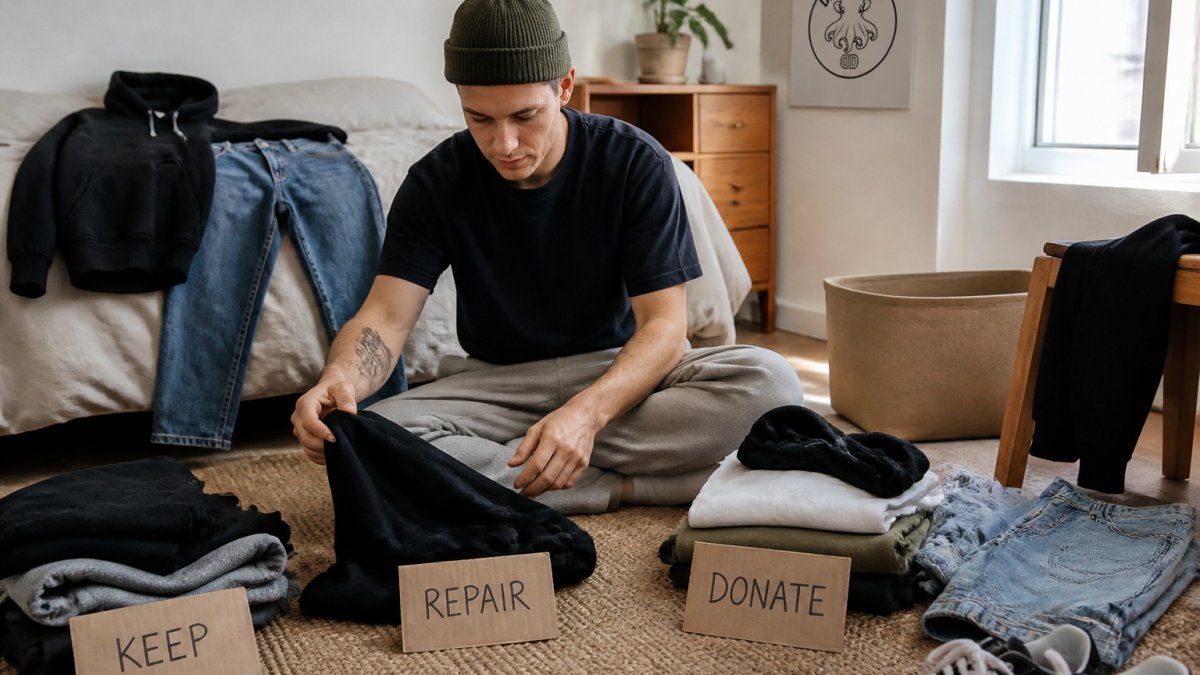
A wardrobe audit is a full sort of everything you wear, done before you spend a penny. It shows you what you reach for, what you avoid, and what needs fixing.
Set aside an hour and work in three piles:
- Keep: worn in the last few months and still fits well
- Repair: good quality but has a loose seam, a missing button or a stain
- Release: wrong size, worn out, or never worn
Be honest about the release pile. A common mistake is keeping clothes for a version of yourself who never turns up.
The Sustainable Streetwear Essentials Worth Owning
Sustainable streetwear essentials are the small set of hard-working pieces you can wear in many combinations. The goal is not a big wardrobe. It is a wardrobe where almost everything gets worn.
Start with these categories:
- Plain T-shirts in two or three neutral colours
- One or two hoodies in a heavy, dense fabric
- Joggers and jeans that fit properly at the waist and ankle
- A light jacket or overshirt for layering
Graphic tees and statement pieces belong too. They just work better when the base is solid. A bold design on a well-made garment lasts years. The same design on a thin, flimsy tee ends up as a rag.
A Sample Starter Capsule
Here is a simple starting point. Adjust the numbers to suit your climate and how often you do laundry.
| Item | How Many | Why It Earns a Place |
|---|---|---|
| Plain T-shirts | 4 | Base layer for almost every outfit |
| Hoodies | 2 | One neutral, one statement piece |
| Joggers | 2 | Comfort without looking careless |
| Jeans | 1-2 | Hard-wearing and easy to style |
| Outerwear | 1-2 | Layering for most of the year |
| Trainers | 1-2 | Everyday wear and a spare pair |
That is roughly twelve to fourteen pieces. It sounds small. In practice, it covers far more outfits than a full rail of clothes you never wear.
Choosing Eco-Friendly Clothing Materials That Actually Hold Up
Eco-friendly clothing materials only help if the garment survives regular wear. A soft organic tee that falls apart in a season is not a better choice than a sturdy one. The second half of that sentence is where most guides stop. If you want to check a brand’s material claims aren’t greenwashing before buying, our guide on how to identify greenwashing in clothing sets out ten checks.
Here is how the main options compare on durability and care:
- Organic cotton: soft, breathable, and widely used in tees and hoodies. Look for a dense knit and a heavier weight; a thin jersey will pill and thin out within a season. For a deeper verdict on whether it is genuinely worth it for streetwear, read is organic cotton worth it for streetwear.
- Recycled fibres: often used in joggers and outerwear. Quality varies a lot because the feedstock varies, so check the stitching and the hand-feel rather than trusting the word “recycled”.
- Hemp and linen: strong and long-lasting, with a distinct texture that suits relaxed streetwear shapes. They crease, so decide whether you will actually iron them.
- Synthetic fabrics: durable and quick-drying, but they shed microplastics in the wash. A mesh laundry bag reduces the load reaching waterways.
How to Verify a Sustainability Claim Before You Buy
Vague claims are common across the fashion industry. A label saying “eco” or “green” means very little on its own.
-
Ask what the garment is made of, specifically. A percentage breakdown by fibre is the minimum. “Sustainable cotton blend” is not an answer.
-
Read the care label as a durability signal. A garment that needs dry cleaning after every wear is a poor fit for a hard-wearing wardrobe.
-
Compare weight and construction, not adjectives. Heavier fabric and tight overlocking tell you more about longevity than any slogan.
-
Be wary of absolute language. “Fully sustainable” and “100% eco” are claims no garment can honestly make, because every piece of clothing has an impact.
If a brand cannot tell you what a garment is made of and where it came from, treat the claim with caution.
A quick test: ask the brand one specific question, such as “which factory made this hoodie?” A clear answer is a good sign. A deflection is an answer in itself.
How to Assess Durability and Construction in the Fitting Room
You can judge most of a garment’s quality in under a minute, without any specialist knowledge. Try these checks:
- Stretch the seam gently. It should hold, not gape or show gaps.
- Turn it inside out. Look for neat, tight overlocking and no loose threads.
- Check the print or embroidery. It should sit flat and feel secure at the edges.
- Feel the fabric weight. Thin, see-through knits wear out faster.
- Look at the waistband and cuffs. These fail first, so check the elastic and stitching.
A common pattern among people who keep clothes for years is that they buy on construction, not on fibre name alone. The fibre matters, but the build is what decides whether you are still wearing it in five years.
Second-Hand Streetwear: Where It Fits in Your Rotation
Second-hand streetwear is a way to add character without adding new production.
Where it fits best:
- Outerwear: jackets and overshirts age well and hold value
- Denim: older jeans often use heavier fabric
- Statement pieces: bold designs you would wear less often
- Accessories: bags, caps and belts are low-risk buys
Check condition before you commit. Look at armpits, crotch seams, collars and cuffs, since these wear first. Ask for measurements rather than trusting a size label, because sizing has changed over the decades.
The Waste and Resources Action Programme has published guidance on extending clothing life, and the principle is simple: every extra year of wear displaces new production.
Cost Per Wear: The Budget Test That Beats Sale Shopping
Cost per wear is the price of a garment divided by the number of times you wear it. It is the single most useful number in a sustainable wardrobe, and it takes ten seconds to work out.
A cheaper piece worn only a few times can cost more per wear than a better piece worn often.
A Worked Comparison
The lesson is not that expensive is better. It is that wear is the variable that matters, and wear is something you can predict from your own habits.
How to Estimate Wear Honestly
Most people overestimate how often they will wear a new piece. Use your existing wardrobe as evidence:
- Count the wears. Pick the three items you reach for most and estimate their annual wears. That is your realistic baseline.
- Match the new piece to a slot. If it does not fill a gap in your rotation, it will not get worn.
- Divide the price by the estimated wears. Compare it with the cost per wear of the pieces you already love.
- Wait a week. Most impulse buys do not survive that pause.
Budget Tiers That Work With Cost Per Wear
Budget planning works the same way: set an amount for the season, then spend it on fewer, better pieces. A simple structure:
- Core tier: the pieces you wear weekly (tees, jeans, joggers). Spend most of your budget here, because these earn their cost fastest.
- Layering tier: hoodies and overshirts. Buy fewer, but buy well.
- Statement tier: graphic pieces and limited designs. Buy one or two a season, and only if they fit your existing palette.
- Repair and care tier: set aside a small amount for mending and alterations.
Cost per wear is not an argument for spending more. It is an argument for wearing more. A modest garment in heavy rotation beats a premium one in the drawer.
Where Cost Per Wear Meets the Lifecycle
The calculation changes at end of life. A piece you can resell or pass on recovers part of its cost, which lowers the effective cost per wear. A piece that cannot be repaired or resold is a sunk cost.
If the number looks high after all of this, do not buy it yet. The pause is the cheapest part of the process.
How to Care for Streetwear So It Lasts for Years
How you care for streetwear decides how long it lasts, often more than the price tag does. A few habits make a real difference.
- Wash less often. Air garments between wears and spot-clean marks.
- Wash cold. Heat can fade prints.
- Turn prints inside out. This can protect graphics from rubbing.
- Skip the tumble dryer. Hang drying helps keep shape.
- Use a mesh bag for synthetics. It can catch fibres during washing.
Repair early. A small stitch now can prevent a split seam later. When a piece truly reaches the end, resell it, donate it, or take it to a textile recycling point rather than binning it.
Streetwear Fit and Outfit Formulas That Keep You Wearing What You Own
Fit is why clothes stay in rotation. A garment that feels right gets worn constantly.
Three formulas that work with a small wardrobe:
- Relaxed top, slim bottom: an oversized hoodie with tapered joggers or straight jeans
- Layered neutrals: tee, overshirt and jacket in tonal shades
- One statement piece: a graphic tee or bold hoodie, everything else plain
Keep the silhouette balanced. If the top is loose, keep the bottom closer to the leg, and the reverse. Neutral colours make mixing simple, because almost everything coordinates.
For more ideas, our guide on how to style recycled joggers for men shows how to keep one pair in heavy rotation.
Join the Deep and Build Your Wardrobe Around Pieces That Mean Something
Building a smaller, better wardrobe takes a shift in how you think about clothes. Fewer pieces, chosen carefully, worn often. That is the whole method.
At DMBO DEEP, we design premium British streetwear around that idea. Our pieces use responsibly sourced garments, including organic and recycled materials, with eco-conscious packaging.
A starter capsule needs a jogger that earns its place. Our Adult Signature Joggers are built for exactly that role. If you want to know who we are and why we make what we make, read our story before you choose.
Frequently Asked Questions
How can I make my streetwear wardrobe more sustainable without spending a lot?
Start with what you already own. A wardrobe audit shows which pieces you actually wear, and repairing a worn hoodie cuff or restitching a hem costs far less than replacing it. Wash less often, use cooler cycles and air-dry garments to slow wear. When you do buy, choose second-hand streetwear or save for one durable piece rather than several cheap ones. Cost per wear, not the price tag, is the measure that matters.
Which fabrics should I look for when buying sustainable streetwear?
Look for organic cotton, hemp, linen and recycled fibres, and check whether the label names the fibre content clearly. Ask how the piece was made and where the material came from.
How do I care for streetwear so it lasts longer?
Turn garments inside out and wash at a cool temperature. Air-dry where you can, as heat can fade prints. Repair small holes and loose seams early, and keep a basic sewing kit so a fix is quick.
Is second-hand streetwear worth buying?
Yes, second-hand streetwear can keep garments in use and out of waste, and it lets you test a style before committing to a new piece. Check the condition carefully before buying, and ask for measurements rather than trusting the label size.
The challenge is not finding more clothes. It is choosing a few pieces you will actually wear, season after season. Get started with DMBO DEEP and build a wardrobe around garments that last, mean something, and support causes worth wearing.
