

How to Verify Fair Trade Clothing Labels in 2026
Table of Contents
- Why Verifying Fair Trade Clothing Labels Matters in 2026
- Fairtrade Mark Meaning: What the Symbol Actually Tells You
- How to Check Fairtrade Certification Step by Step
- Ethical Clothing Labels and Certifications: The Main Marks Compared
- How to Spot Greenwashing in Fashion Without a Certification Database
- Building Long-Term Confidence in Fair Trade Clothing
- Conclusion
- Frequently Asked Questions
Last Updated: 5 October 2026
Why Verifying Fair Trade Clothing Labels Matters in 2026
Knowing how to verify fair trade clothing labels is now a basic skill for anyone who cares where their clothes come from. The problem is that certification marks look official, but not all of them mean the same thing. Some cover the cotton. Some cover the factory. Some cover the whole supply chain. And a growing number of brands use in-house logos that look like certifications but are not.
This guide from DMBO DEEP breaks down what each major mark actually guarantees, and how to check it in minutes.
The stakes are real. A 2024 European Commission study found that 59% of green claims made by fashion brands were vague, misleading or unfounded. That is why regulators are tightening the rules, and why the EU Green Claims Directive now requires brands to back up environmental statements with evidence.
So how do you tell a genuine certification from a marketing badge? Below, we show you exactly how to check, mark by mark.
Fairtrade Mark Meaning: What the Symbol Actually Tells You
The Fairtrade Mark is a certification awarded by Fairtrade International. It confirms that farmers and workers in the supply chain received a minimum price for their crop, plus an extra premium to invest in their community.
That is the key point. The mark is about fair pay for producers, not about the environmental footprint of the garment.
The FAIRTRADE Mark vs the Fairtrade Cotton Mark
These two marks are often confused. They mean different things.
| Mark | What It Covers | Who Sets It |
|---|---|---|
| FAIRTRADE Mark | The specific ingredient, such as cotton | Fairtrade International |
| Fairtrade Cotton Mark | Cotton only, not the finished garment | Fairtrade International |
| Fairtrade Sourced Cotton | Cotton sourced on Fairtrade terms | Fairtrade International |
Here is the catch most shoppers miss: a T-shirt can carry the cotton mark while the factory that sewed it pays no living wage at all. The mark is honest. It is just narrower than people assume.
A common mistake is assuming a Fairtrade cotton mark means the whole garment is ethically made. It does not. The mark covers the cotton sourcing only, so check for a separate factory-level certification if worker welfare matters to you.
How to Check Fairtrade Certification Step by Step
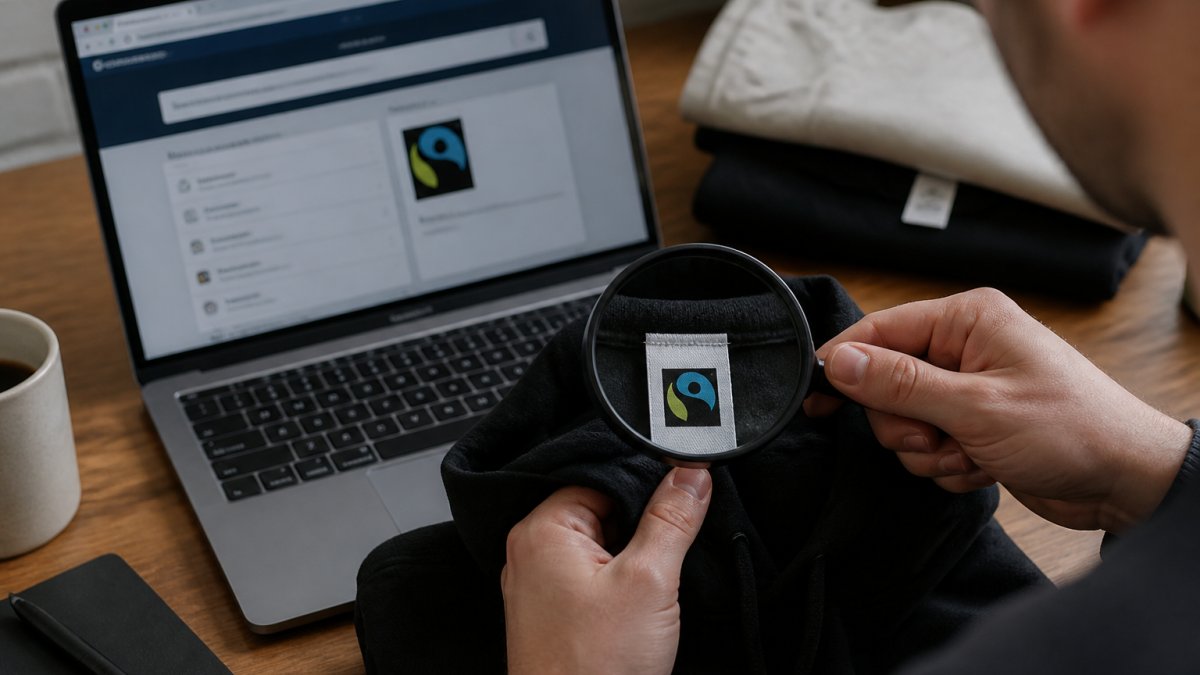
Checking a Fairtrade claim takes about five minutes. The steps below work for any garment, in a shop or in your wardrobe.
- Find the certification logo on the label or swing tag
- Note the licence number printed beside it, if there is one
- Search the official certification body’s online database
- Match the brand name, product and licence number
- Check the scope: does the certificate cover cotton, the factory, or both?
- Look for a date. Expired certificates are a red flag
- If nothing matches, ask the brand directly and keep the reply
What to Do When a Label Is Unclear
Unclear labels are common, and they are not always dishonest. Some small brands use a supplier’s certificate that never gets printed on the tag.
- Email the brand and ask which body certified them
- Ask for the certificate number, not just the logo
- Check whether the claim covers the fabric or the finished product
- Give the brand a reasonable window to reply, then decide
If a brand cannot name its certifier, treat the claim as unproven. That is not an accusation. It just means you have nothing to verify against.
Ethical Clothing Labels and Certifications: The Main Marks Compared
Ethical clothing labels fall into three broad groups: fair pay marks, organic fibre marks, and factory-level social audits. Knowing which group a logo belongs to tells you what it can and cannot prove.
| Certification | Main Focus | What It Does Not Cover |
|---|---|---|
| Fairtrade International | Producer prices and premiums | Factory working conditions |
| GOTS | Organic fibre and processing | Fair wages |
| OEKO-TEX | Harmful substances in textiles | Labour practices |
| B Corp | Overall company conduct | A single garment |
| SA8000 | Factory social standards | Fibre sourcing |
The useful move is to read the marks together. A garment with both a Fairtrade cotton mark and a factory social audit covers more ground than one with either alone. That is the difference between a single claim and a full picture.
How to Spot Greenwashing in Fashion Without a Certification Database
Spotting greenwashing comes down to one test: can the claim be checked by someone other than the brand? If not, it is marketing, not proof.
Watch for these signals:
- Vague words like “eco”, “green” or “conscious” with no standard behind them
- A logo that mimics a real certification but appears nowhere else
- Claims about one part of the garment presented as covering all of it
- No certifier named, no number, no database entry
- “Sustainable” used as a mood rather than a measurable claim
A 2022 study published in the Journal of Consumer Policy on greenwashing found that vague claims were the single most common form of misleading environmental marketing. The fix is simple: ask for the standard, the certifier and the number.
At DMBO DEEP, we keep our claims narrow and specific. We use responsibly sourced garments, including organic and recycled materials, and a contribution from every item sold supports ocean conservation and mental wellbeing. We would rather state exactly what we do than stretch a word to sound bigger.
When a brand claims a certification, ask for the certificate number. Genuine certifiers publish searchable registers, so a real number takes seconds to confirm. A brand that cannot produce one is either uncertified or disorganised. Both are worth knowing before you buy.
Building Long-Term Confidence in Fair Trade Clothing
Long-term confidence comes from habits, not one-off checks. Once you know which marks matter to you, you can scan a label in seconds and move on.
- Save the databases for the marks you see most often
- Follow a short list of brands whose claims you have already checked
- Re-check annually, since certificates expire and supply chains shift
- Treat every new logo as unverified until you have looked it up
Limited-run and small-batch brands often have tighter, more traceable supply chains than mass producers, simply because there is less to hide. That is one reason we cap our Limited Edition collections at 250 pieces. It keeps the chain short and the claims checkable.
Conclusion
The gap between a real certification and a convincing logo is where most shoppers get caught out. Closing it takes one habit: ask who certified the claim, then check it. That single question separates proof from packaging, and it works on any label you will ever pick up.
At DMBO DEEP, we build around that idea. Our Limited Edition drops are capped at 250 pieces, £2 from every purchase goes to ocean conservation and mental health causes, and every order ships in eco-conscious packaging. Premium streetwear, limited by design.
Join the Deep and wear something you can actually stand behind.
Frequently Asked Questions
How can I tell if a clothing label is genuinely Fairtrade certified?
Look for the official FAIRTRADE Mark or Fairtrade Cotton Mark on the garment label. These marks only appear on products that meet Fairtrade International standards and have been independently audited. You can verify the licence number on the Fairtrade International website. If a brand uses vague terms like ‘fair trade inspired’ or ‘fairly made’ without a certification mark, the claim is unverified. Genuine Fair Trade clothing certification always comes with a traceable licence and audit trail.
Does Fairtrade certification cover the whole garment or only some materials?
Fairtrade certification typically covers specific materials, most commonly cotton. A T-shirt might carry the Fairtrade Cotton Mark because its cotton is certified, but the polyester, dyes or labour used in finishing may fall outside that certification. This means a garment can be partly Fairtrade certified without being fully ethical. Always check whether the mark applies to the whole product or just one component, and look for additional certifications for other materials.
Can a brand call its clothes fair trade without certification?
In the UK, brands can use the term ‘fair trade’ descriptively, but they cannot use the official FAIRTRADE Mark without certification. Some brands use phrases like ‘fair trade practices’ or ‘fairly traded’ to imply ethical sourcing without independent verification. This is a common greenwashing tactic. If you cannot find a certification mark or a licence number, treat the claim as marketing language rather than a verified standard.
What should I do if a clothing brand’s ethical claims are unclear?
Start by checking the brand’s website for specific certification names and licence numbers. If they do not publish this information, email their customer service and ask directly which certifications they hold and who audits them. You can also search the Fairtrade International database or contact the certifying body. If the brand avoids answering or gives vague responses, that is a red flag. Ethical Clothing labels and certifications should be easy to verify, not hidden behind marketing language.